
A staggering 75% of South Africa’s workforce can be classified as Deskless Workers.
Considering the country’s approximate working population of around 25 million people in 2023 (according to StatsSA), this means over 18.75 million South African employees are deskless.
But what exactly is a deskless worker? What are their challenges and opportunities? And what are the unique opportunities for South African businesses for whom deskless workers make up a significant percentage of their employee base?
Jem HR recently released the latest version of the Deskless Worker Pulse, a report offering an unprecedented look into this group that makes up two-thirds of SA’s workforce.
As the name suggests, they are employees who perform their jobs away from traditional office settings (they have no desk). These include cashiers, factory workers, truck drivers, security officers, miners, cleaners and many more roles essential to the smooth functioning of society – including many frontline workers.
Because they are, by nature, not all concentrated in an office building (like most people reading this post are), deskless workers and their HR teams face distinct challenges.
Due to the nature of their work, deskless teams normally don’t have access to the internet or traditional communication tools, and they might work long hours in remote or far-flung locations.
This makes everything from onboarding, training, development and even basic HR management extremely difficult. A task as simple as as delivering payslips becomes a complex logistical puzzle to solve when you have hundreds of workers scattered around the country. And that’s before we discuss the associated costs of doing this manually.
And deskless workers make up the bulk of SA’s workforce – 75%, meaning that having accurate data and insights into their challenges and opportunities can unlock an enormous amount of value, cost savings and efficiency for employers.
That’s why Jem released the Deskless Worker Pulse, an annual research document dedicated to the deskless workforce and their employers.
Here are some unprecedented insights into deskless employees in South Africa.
77.9% of SA’s Deskless Workers are between the ages of 25 and 44. In fact, while only 28% of the national workforce is aged 22–34, they make up the bulk (42.2%) of the country’s entire deskless workforce.
The next largest cohort is 35- to 44-year-olds, making up 35.7% of all deskless employees in South Africa. People over 45 make up less than 16% of the deskless worker base, while the national average for this age group is 34%. This might be an indicator that deskless workers progress to more senior positions with age – ones that are likely less physically demanding or even office-based.
This is supported by a positive datapoint from the Deskless Worker Pulse, where it was discovered that 60% of deskless employees know what steps to take in order to get promoted in their role.
64.7% of SA’s deskless workers are male and only 35.1% are female. This makes sense considering the nature of some deskless jobs – construction and security, for example, are incredibly physically demanding and have high safety risks. While gender-normative standards and perceptions of the roles women can play in the workplace are evolving, it’s clear that plenty of progress is still required.
The national workforce reflects a more even split, being comprised of 43.8% women. This is significantly higher than the average of women in deskless roles. And, if 77.9% of workers are deskless, that means nearly 80% of the work opportunities are deskless. Unfortunately, this points to the fact that women are missing out on the bulk of work opportunities in the country.
This highlights opportunities for employers to take action and be able to attract more women to deskless roles to promote equality in the workplace.
Jem interviewed over 1,600 deskless employees across a range of industries and found that 54% work in the security industry – an extremely fast-growing sector in South Africa.
Other notable industry stats are:
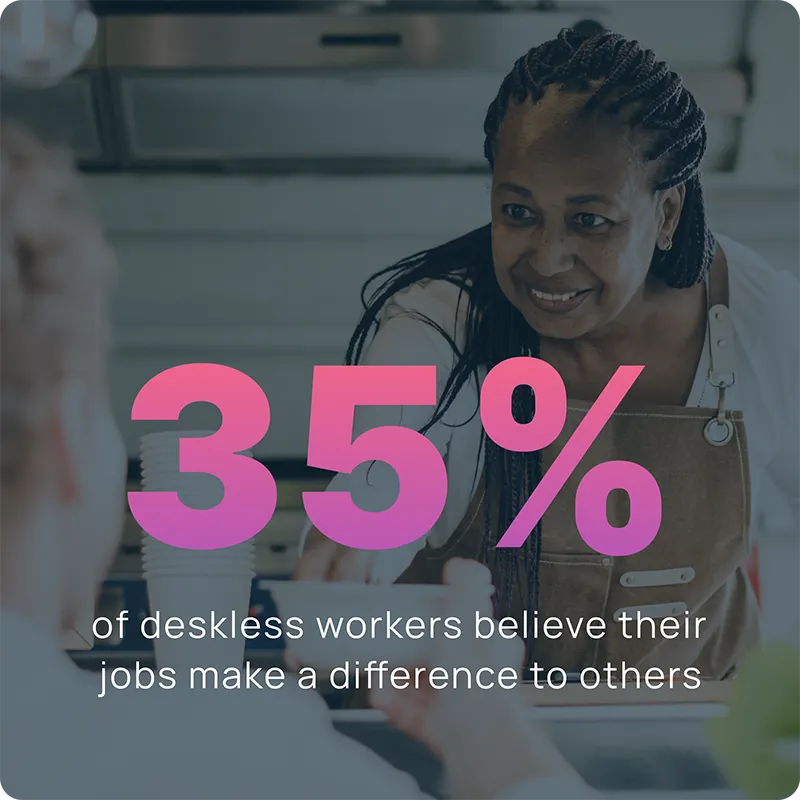
98% say they love their jobs, with 35% saying they chose their job because it makes a difference in other people’s lives. Only 33% say they chose their job purely because it’s the most efficient way for them to acquire the money needed to provide and care for their families.
Interestingly, only 15% felt a remarkable loyalty to their employer, saying the company recognises their efforts and rewards hard work. Could this potentially indicate that employers have some work to do in refining their rewards and appreciation programmes?
While 49% of deskless workers feel adequately recognised for their work, a significant portion remains in the shadows. Nearly 26% feel acknowledged only occasionally, and 25% report that their efforts are rarely, if ever, recognised.
This lack of consistent acknowledgement creates a massive gap for employers to step in and make a difference. Regular recognition programmes and performance feedback could help address this gap and foster a stronger sense of value and engagement among deskless workers.
The top three stressors for deskless workers are unreliable transport (33%), unclear communication from employers (27%), and low wages (20%).
Transport issues can lead to workers arriving late, missing shifts, or even facing dangerous situations when travelling to unfamiliar locations. Add to this poor communication, such as sudden shift changes or unclear expectations, and workers face significant daily frustrations.
Employers can address these by offering transport subsidies or improving communication processes, such as mobile-first scheduling tools.
These findings are just a snapshot of the challenges and opportunities surrounding South Africa’s deskless workforce. For a deeper dive into the data, download Jem HR’s full Deskless Worker Pulse research report and discover how to better support the workers who keep South Africa moving.
Jem is an HR digitisation specialist for employers of deskless workers in South Africa. We help future-proof their HR with unique and powerful WhatsApp-based HR tools (because all deskless workers use WhatsApp and it’s the best way to get ahold of them), including:
We’ve helped numerous SA companies save hundreds of thousands of Rands per year on payroll and HR admin and resources. And we can do the same for you – book a demo here.
Plus: Want to reduce company expenses? Our tools are proven to boost retention – see how much you can save per year with our employee turnover savings calculator.


Book a demo and walk through every module live, or see it on WhatsApp, on a real phone, in minutes.